Autism Acceptance Month is an opportunity to move beyond awareness and toward meaningful inclusion. Yet for many autistic adults, that goal remains out of reach in the workplace. Despite having the education, skills, and motivation to succeed, autistic individuals continue to experience disproportionately high rates of unemployment and under-employment. For years, efforts have focused on preparing individuals for work, as well as emphasizing training and readiness. Although important, that approach alone has not closed the gap, prompting researchers, like Melinda Henson, to look more closely at the environments autistic professionals are entering.
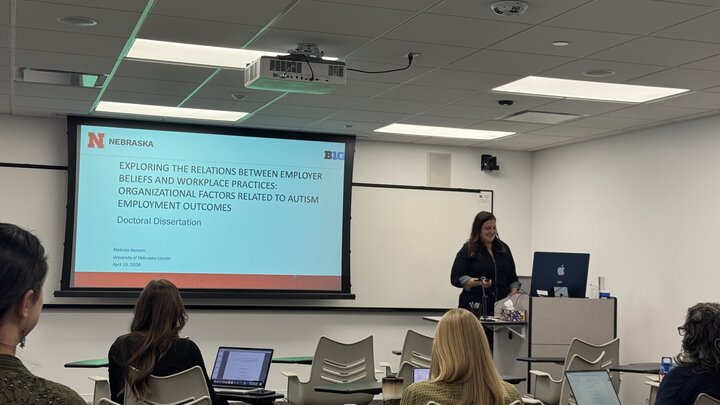
Doctoral researcher Melinda Henson set out to examine that environment in her dissertation, Exploring the Relations Between Employer Beliefs and Workplace Practices: Organizational Factors Related to Autism Employment Outcomes. Rather than focusing solely on individual factors, Melinda explored how organizational dynamics, specifically employer beliefs about autism, hiring receptivity, and workplace practices, are associated with employment outcomes for autistic professionals. Her goal was not only to better understand persistent disparities but to identify where change could occur within the systems that shape employment opportunities.
Her findings suggest a disconnect that challenges common assumptions about workplace inclusion. Many employers report implementing inclusive practices such as flexibility, support systems, and opportunities for advancement. However, these efforts were not linked to improved employment outcomes for autistic individuals. Instead, the strongest predictor of outcomes was employer beliefs about autism, including how autism is understood within the workplace and whether it is viewed primarily through a deficit-based lens or as a form of neurodiversity.
For Melinda, this suggests a potential shift in how inclusion efforts should be approached. Policies and programs matter, but they are not enough on their own. When underlying beliefs about autism remain rooted in a deficit-based framework, even well-intentioned practices may fail to translate into meaningful opportunities or experiences. Her research emphasizes the need for organizations to examine not only what they are doing, but how their perspectives shape those actions and how employees experience them.
These findings also raise questions about how organizations define and measure inclusion. Reporting the presence of inclusive practices is different from evaluating their effectiveness. Suggesting organizations should look beyond self-perception and consider whether their efforts are producing meaningful outcomes for autistic employees. This may involve seeking direct feedback, examining advancement and retention patterns, and being willing to adjust approaches when gaps are identified.
Finally, her research underscores the importance of ongoing education and reflection. Shifting beliefs about autism is not a one-time effort, but a continuous process that requires engagement, training, and a willingness to challenge long-held assumptions. By deepening their understanding of neurodiversity, organizations can create environments where inclusion is not only intended but consistently experienced in day-to-day work.
Through her research, Melinda aims to move the conversation forward, encouraging organizations to go beyond surface-level inclusion and toward deeper, more impactful change. As Autism Acceptance Month invites reflection, these findings serve as a reminder: improving awareness is key to employment outcomes and defined opportunity.