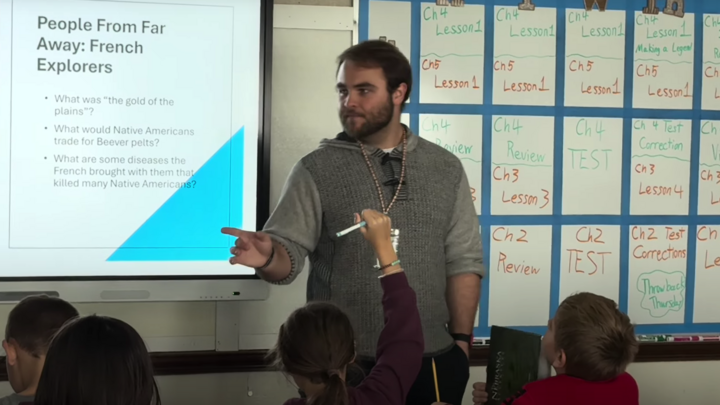
In celebration of National Reading Month, the College of Education and Human Sciences is highlighting the impact of our graduates’ literacy preparation in Nebraska classrooms. In this Q&A, alum Lucas Timm (TLTE ’25) shares how he is making a difference in his first year at Mead Public Schools, teaching science and social studies to fourth- through sixth-grade students while bringing a thoughtful, student-centered approach to reading across content areas.
What led you to pursue your education degree with CEHS?
When I was growing up, I didn’t really know what I wanted to do outside of school. When it came time to start thinking about my future, I looked to the people around me whom I looked up to and realized they were all teachers, so I figured I’d give that a shot. When it came time to choose a school, it was an easy choice. As the son of two Husker alumni and a lifelong Husker football fan, I knew where I wanted to go.
What inspired you to become a teacher, and what do you enjoy most about the profession?
I was influenced by many of the teachers I grew up with. They all cared deeply about my personal success, and I am still in touch with many of them today, especially my high school coaches. My favorite part about being a teacher is developing meaningful relationships with students. I make sure every student who walks into my room knows I care more about who they are than what they know.
How did your experience in CEHS influence your perspective on reading instruction and literacy development?
It changed my whole perspective. I used to believe reading was just something you had to do, instead of an opportunity you get to have. Reading doesn’t always come easily for every child, and it can be challenging even for experienced readers. I came into college knowing about reading disorders like dyslexia and hyperlexia, but I didn’t fully understand their impact. After my time at the Kit and Dick Schmoker Reading Center, I realized how much of a gift it is to be able to read and how important it is for students who struggle to receive individualized support to develop their comprehension.
Which courses, instructors or experiences had the greatest impact on your preparation to teach reading and literacy?
There were many courses that helped me become the teacher I am today, but any course taught by Nick Husbye was always my favorite. He has a way of breaking down the more complex aspects of reading to make them easier to understand and apply when helping students. His class wasn’t easy, but what I learned helped me prepare for the Praxis exam, which I passed on my first attempt. I even used the same note cards I created for his class while studying for the exam.
How do you apply what you learned about reading and literacy in your classroom today?
Science and social studies are complex subjects with a significant amount of reading. If a student struggles with comprehension or decoding words, they may fall behind. From the UNL reading program, I learned the importance of slowing down and making sure all students understand the material, not just those raising their hands. That includes individualized work, personal check-ins and paying attention to how students are responding to a lesson.
What stands out to you about your experience working in the Reading Center?
I had the opportunity to work with a very sweet student who has dyslexia. When we first started, she seemed shy and almost ashamed of her reading ability. As someone who values relationships over content, I made it my goal to ensure she felt supported and recognized for her strengths. When she shared that she enjoyed the show Gravity Falls, I created a targeted reading lesson that incorporated its characters. By the end, we made meaningful progress, and it was great to see her joyful personality shine through as she gained confidence in her reading.
What is one strategy or approach from your training that you regularly use with your students?
I use a lot of review games, especially for vocabulary. I incorporate platforms like Quizlet, Gimkit, Blooket and Kahoot to reinforce repetition. Beyond games, I also use multisensory approaches. For example, if a student is confused about a science concept, I may use an activity or lab to demonstrate it rather than relying solely on reading. I have a student who struggles with reading but is a strong auditory learner, so we do verbal recaps after each lesson to review key points. He has improved significantly because of this approach.
How has your training shaped the way you support students with varying reading abilities?
I often adapt tests and worksheets to make concepts clearer for students who have difficulty focusing or reading. This helps them better comprehend what I am teaching.
Why is strong preparation in literacy instruction important for teachers serving Nebraska’s students and communities?
If a teacher doesn’t fully understand the material, it is difficult for students to understand it. Preparation allows teachers to plan adjustments for struggling learners while also deepening their own understanding. I’ve found that preparing lessons a week or two in advance makes it much easier to answer students’ clarifying questions on the day of instruction.
Is there anything else you’d like to add about your experience or your work as an educator?
I am really enjoying my work as a teacher and look forward to pursuing my master’s degree so I can continue teaching for many years. This is all thanks to the amazing teachers I had growing up and the phenomenal educators at UNL. Go Huskers!
College of Education and Human Sciences
Teaching, Learning & Teacher Education
AlumniNews