Mosaic Down syndrome is a genetic condition in which only a percentage of a person’s cells contain an extra copy of chromosome 21, resulting in a mixture of normal and trisomic cells. This variant of Down syndrome is less common than full trisomy 21 and can lead to a wide range of physical and cognitive outcomes, depending on how many cells are affected and where they are located in the body. Researchers estimate mosaic Down syndrome accounts for about 1-2% of all Down syndrome cases.
Down syndrome in all forms is caused by an extra copy of chromosome 21, which alters development and leads to characteristic physical features and varying degrees of intellectual disability. Mosaicism occurs when the chromosomal error arises after fertilization during early cell division, leading to a population of mixed genetically normal and trisomic cells. However, because not all cells carry the extra chromosome, individuals with mosaic Down syndrome may exhibit milder features or fewer health complications, making it significantly harder to detect and diagnose compared to Full Trisomy 21 Down syndrome.
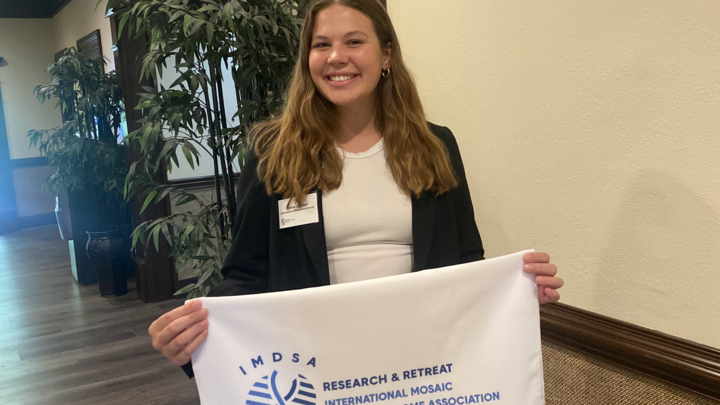
For Emma Conradi, a master’s speech-language pathology student at UNL, this 1-2% is what caught her eye while working in Dr. Susan Loveall’s Learning Lab for Intellectual and Developmental Disabilities. While in her lab as an undergrad and early on in her master’s program, Emma had the opportunity to help Dr. Loveall with her NIH grant: Language and Reading Comprehension of Students with and without Developmental Disabilities. It was here Emma learned the scarcity of research and knowledge on mosaic Down Syndrome due to its rarity. Looking back at a conference hosted by the International Mosaic Down Syndrome Association, Emma stated, “…it was so cool being there connecting with the individuals with mosaic Down syndrome and their families, and hearing the parents say, 'there’s very little research out there…’”
From there, Emma crafted her master’s thesis on the language and reading abilities of individuals with mosaic Down syndrome. Her thesis, which was a hit, helped her travel to conferences nationwide, where she had the opportunity to present her project and inform other students, clinicians, and researchers alike of the importance of understanding mosaic Down syndrome.
Now, Emma is fulfilling her school externship requirement Omaha Public Schools. This semester Emma has the opportunity to work in an educational setting with elementary students, some of them with Down syndrome. During this semester Emma is excited to understand the importance of early intervention and the impact it has on students. In the summer, Emma will transition to a medical setting, where she will understand the nuances of clinical research, practices, and treatments for individuals in a rehabilitation setting. When asked about which setting she prefers best, she remarked, “I honestly don’t know…both are crucial to formulating research and helping people across all phases of life, which is something I am super excited about going forward…”
Diagnosis of mosaic Down syndrome typically relies on genetic testing such as a karyotype analysis or chromosomal microarray that examines multiple cells to determine the proportion of trisomic cells. Prenatal screening may overlook mosaicism because standard screens sample a limited number of cells. Postnatal diagnosis often follows suspicion based on developmental delays, physical traits, or specific medical concerns.
Research into mosaic Down syndrome continues to improve understanding of how the distribution of trisomic cells affects long-term development and health. Experts stress early intervention, inclusive education, and family support as key factors in helping every child reach their potential. With organizations like International Mosaic Down syndrome providing resources for clinical care, family guidance, and community resources, many children with mosaic Down syndrome can access the support needed to thrive.
In her future, Emma hopes to work with pediatrics with Down syndrome, where her research, alongside other researchers, will help her inform families how to self-diagnose, as well as where to go for a proper assessment, diagnosis, and intervention plan.