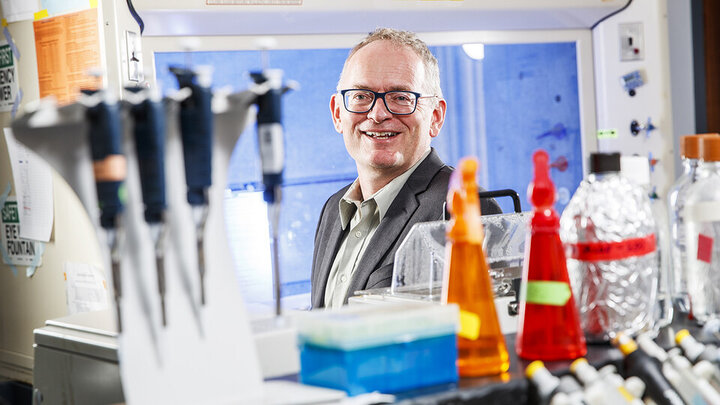
Janos Zempleni has spent more than two decades studying how nutrition changes the way genes behave — work that was launched through support from Nebraska’s tobacco settlement research fund.
Zempleni, a Willa Cather Professor of Nutrition and Health Sciences, joined the University of Nebraska–Lincoln faculty in 2001, the same year Nebraska lawmakers approved legislation directing a portion of the state’s tobacco settlement dollars toward biomedical research. Created under Legislative Bill 692, the Nebraska Tobacco Settlement Biomedical Research Development Fund was intended to help research institutions recruit top scientists, build infrastructure and leverage state dollars to attract federal funding.
Nebraska was among a small number of states nationally to invest tobacco settlement funds entirely in health care and research. On Jan. 9, state and university leaders gathered at the Nebraska Capitol in Lincoln to mark the 25th anniversary of the Health Care Cash Fund. Speakers at the event said the decision to dedicate tobacco settlement dollars to health research was among the legislature’s most impactful choices and has generated significant returns in the form of research dollars and recruited talent.
Zempleni first received tobacco settlement support in 2003. The investment helped him establish a laboratory and launch a research program focused on epigenetics — the study of how nutrients can influence gene activity. Additional funding supported lab development, faculty retention and a 2009 cross-campus initiative, the Nebraska Gateway to Nutrigenomics, which strengthened collaboration across the University of Nebraska system.
“That gave us the ability to establish a program and attract additional funding,” Zempleni said.
Since then, Zempleni has built a research portfolio totaling about $30 million, supported in part by approximately $1.26 million in tobacco settlement funding — a return of nearly 24 to 1.
The early investments helped the university secure all three phases of National Institutes of Health funding for a Center of Biomedical Research Excellence, leading to the 2014 creation of the Nebraska Center for the Prevention of Obesity Diseases. The center studies naturally occurring compounds such as choline, fiber and omega-3 fatty acids to prevent and treat obesity-related diseases, including Type 2 diabetes and cardiovascular disease.
About 40% of Nebraskans are affected by obesity-related illnesses. The center conducts intervention studies in underserved Nebraska communities and in Native American populations, focusing on affordable and practical solutions.
Fifty-nine faculty members from 26 departments at UNL, the University of Nebraska Medical Center and the University of Nebraska at Omaha contribute to the center’s work. In September 2024, the center received a third round of NIH funding.
Beyond obesity research, Zempleni’s team was the first to demonstrate that milk-derived exosomes are bioavailable and can influence gene regulation and metabolism. The findings have implications for infant nutrition and cognitive development and researchers are exploring whether milk-transported genetic material could be used to target a gene linked to brain tumors.
Zempleni is a fellow of the American Association for the Advancement of Science and ranks among the top 2% of most-cited researchers worldwide.
The University of Nebraska’s progress report says UNL invested $2.74 million from the tobacco settlement fund in 2023-24 for faculty recruitment and retention, research infrastructure, minority health research and joint projects with other NU campuses. The funding helped UNL leverage more than $46 million in external research dollars during the same period. Across the University of Nebraska system, tobacco settlement funding has helped leverage more than $300 million in external research support since 2001.
College of Education and Human Sciences
Nutrition and Health Sciences
Comprehensive Health & Well-Being