Theresa Catalano, professor of teaching, learning and teacher education, spent two weeks in Indonesia as part of the Fulbright Specialist Program last September. Now that she’s back on campus at the University of Nebraska-Lincoln, she’s bringing the lessons from Indonesia to her classes.
“If anyone is ever considering being a Fulbright Specialist, I highly recommend it,” Catalano said. “It’s different than just traveling to a country. You are immersed in it. It’s transformative. It changed my life and the way I look at the world.”
This wasn’t Catalano’s first experience with the Fulbright program. When she was an elementary teacher early in her career, she traveled to Pakistan as part of a group from the University of Nebraska at Omaha that took teachers there. She had her second Fulbright experience a few years ago, accompanying Jenelle Reeves, also a professor of teaching, learning and teacher education, to South Korea as part of a Fulbright award to take teachers to that country. Catalano has also served as an academic advisor to three Fulbright doctoral students studying in the United States.
Catalano connected with Indonesia thanks to a former doctoral student who studied political science at Nebraska, Fathiyyah Maryufani. Catalano, whose expertise lies in critical discourse studies, co-chaired Maryufani’s dissertation committee. Critical discourse studies examine the relationship between language, ideology, power, and social change.
In 2025, Maryufani was a faculty member in communication studies at Universitas Pendidikan Indonesia (UPI) and invited Catalano to visit the university. After Maryufani applied for the AMINEF program, Indonesia’s local office for the Fulbright Exchange Program, Catalano applied and was accepted to the Fulbright Specialist Program to engage with students and faculty at UPI.
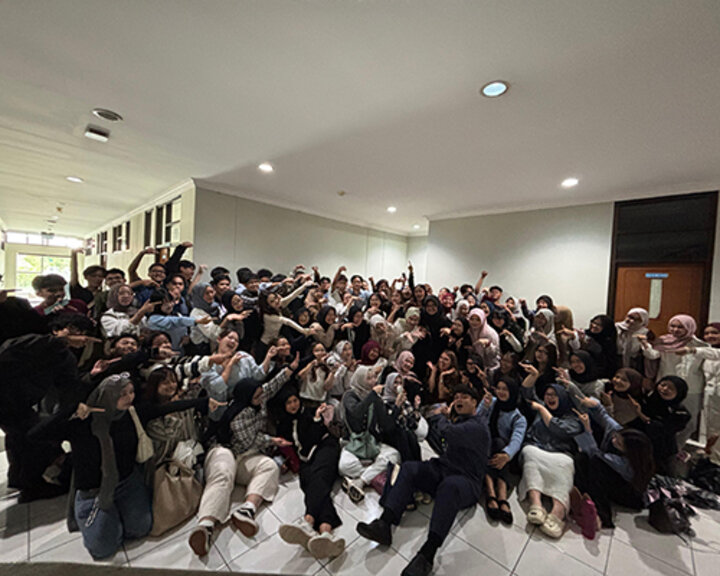
Shortly before her arrival, Indonesia experienced political unrest across the country. Fortunately, things calmed around the time she arrived, so she was able to engage with faculty and students as planned during her second week after students were all online during the first week.
“My topics were about social media and politics,” Catalano said. “How do we know what the truth is, for example? I tried to bring what was happening in Indonesia into my presentations. I was going into a context where there was huge political unrest so that made what I was doing even more meaningful to the students and they were really engaged.”
During the two weeks she was there, Catalano provided five guest lectures to students and faculty in the Communications and Linguistics Departments at UPI. In addition, she led a workshop on international publishing, mentoring faculty in publishing in academia and interdisciplinary work. She and Maryufani also submitted a journal article and completed a chapter for a book on digital discourses of national identities.
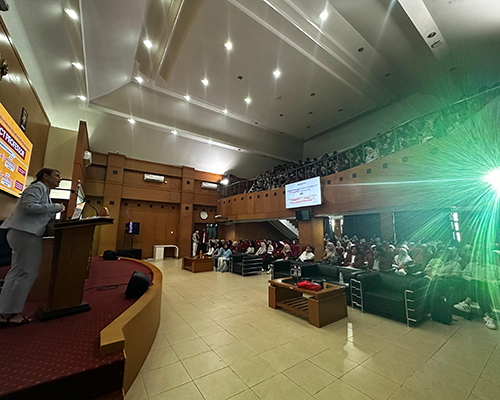
Since returning, Catalano has become an international partner on two research teams in Indonesia, one that is working on the semiotic analysis of a traditional Indonesian dance and another that utilizes her knowledge of critical discourse studies to analyze Indigenous tourist guides as part of a project on Indigenous tourism narratives and local wisdom.
Back in her classroom in Nebraska, Catalano is bringing the perspectives she gained during her two weeks in Indonesia into the lessons she shares with her students.
“As a professor in an education department, I prepare teachers to work with students with immigrant/refugee backgrounds,” Catalano said. “Being in Indonesia and trying to learn the language refreshed my understanding of what it means to be new to a language and country, and how hard it is, and things that teachers need to consider. The experience helped me come up with new examples for the language teaching methods courses I teach, and for my linguistics class. For instance, Indonesian features a plural that is formed by doubling the word, like the word ‘anak’ means child but ‘anak-anak’ means children. These are great examples I can give my students and I’ve also gained examples for my intercultural communication and multimodal analysis class.
“I’ve traveled around the world but every time I go to a new place, I learn so many new ways of viewing the world and of looking at something and interpreting it differently. It enhances my teaching and my research, and I hope that I can pass that knowledge on to my students.”
College of Education and Human Sciences
Teaching, Learning & Teacher Education
Strong Communities