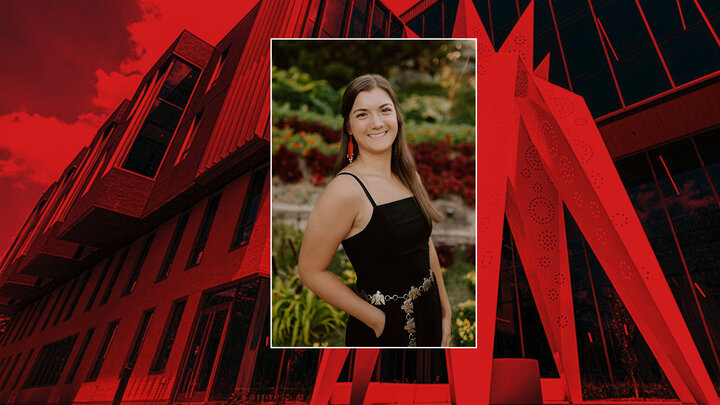
As the first climate and health resilience coordinator for the Lincoln-Lancaster County Health Department, CEHS alum Maizie Humm ('20) is helping lead efforts to prepare the community for the growing health impacts of extreme weather. Humm has played a key role in developing the Lincoln-Lancaster County Heat Response Plan, a collaborative initiative designed to protect residents and strengthen community resilience toward extreme heat. Read more to learn how her experiences in the College of Education and Human Sciences helped shape her passion for public health and led her to a career making a difference in the Lincoln community.
Can you share a little about yourself, including your background, time in the College of Education and Human Sciences, and what you are up to today?
I was born and raised in Lincoln. I have a large, blended family, including seven siblings, and I am a first-generation college graduate! I am also a first-generation descendant of the Prairie Band Potawatomi Nation. I never really thought going to college would be a possibility for me. That was until Kris Ross, an Indian education advocate for Lincoln Public Schools, helped me realize it was possible and provided crucial guidance along the way. I was fortunate enough to receive a full-ride scholarship through the Susan T. Buffett Foundation. It changed my life. I received two bachelor’s degrees from UNL, including one in Community Health and Wellness and one in Sociology. After my time at UNL, I moved to Colorado and obtained a Master of Public Health degree in Global Environmental and Occupational Health from the University of Colorado-Anschutz. I ended up moving back to Lincoln and started at the Lincoln-Lancaster County Health Department as the first climate and health resilience coordinator.
You earned your B.S. in Nutrition and Health Sciences, Community Health and Wellness—what drew you to that major, and how did your time in the program shape your career path?
Growing up, I was always drawn to careers in the medical field or academia. After job shadowing a clinical heart perfusionist during open heart surgery, I unfortunately realized that is not the ideal career path for me. I started off as a nutrition science major, as I’ve always had an interest in health and wellness, but now I wasn’t sure what I wanted to do as a career. I continued the nutrition science path, but during my sophomore year, they re-introduced the community health and wellness option. I was immediately drawn to this major as it combined my two biggest passions—health and education.
During my junior year, I took Introduction to Sociology. The concepts aligned perfectly with what I was learning through my community health and wellness major and helped me realize how impactful social and cultural dynamics are on individual and community health outcomes. This sparked my interest in health equity and how certain systems create and perpetuate disproportionate health outcomes. I was also pursuing a minor in environmental studies. The combination of all these topics led me to want to understand how climate change will impact health, both at the individual and community level.
Were there any classes, faculty members, or experiences that were especially influential on your journey?
Yes, many! A few courses that come to mind include Environmental Sociology which helped me better understand the social dimensions of environmental issues, especially social inequality and environmental justice. In addition, the Social Psychology of Inequality furthered my understanding of how social structures and processes contribute to or maintain social inequalities. These courses influenced my undergraduate thesis project, where I conducted a systematic literature review titled “The Relationship Between Anthropogenic Climate Change, Poverty, and Health Equity” which illustrated the disproportionate impacts of climate change on disadvantaged individuals.
I also job shadowed multiple times throughout my college career. I job-shadowed a clinical heart perfusionist during open heart surgery, which made me realize I was not cut out for that career path and ultimately led to me discovering public health. Then, I job shadowed a public health educator at the Lincoln-Lancaster County Health Department (LLCHD)—which is where I currently work!
Lastly, I studied abroad in Spain and walked 200 miles of the Camino de Santiago as part of the sociology of religion course. It was not directly related to my career path, but it was my first time overseas and opened my eyes to different cultures and experiences, and helped me think about climate and health on a global scale.
You are currently the climate and health resilience coordinator at Lincoln-Lancaster County Health Department. Can you share more about that work and how it impacts the Lincoln community?
It is a newly developed position, and I am the first person in this role. I’ve been in this position for three and a half years. The focus is on building our community’s resilience to the health impacts of climate change, starting with extreme heat. This is important because by 2050, the average temperature in Lincoln is projected to be 5 degrees warmer and we will see a 340% increase in the number of days with a heat index over 100 degrees. The number of heat-related illnesses in our community has already more than doubled since 2014. But it’s more than just heat-related illnesses; extreme heat can exacerbate chronic health conditions, threaten our food systems, and strain critical infrastructure such as hospital systems, transportation, housing, and power grids. Everyone is affected by extreme heat, but the impacts are not felt equally throughout our community. The development of the Lincoln-Lancaster County Heat Response Plan reflects a proactive, community-driven approach to climate resilience.
Can you share more about the Lincoln-Lancaster Heat Response Plan?
The Lincoln-Lancaster County Heat Response Plan was officially launched in May 2025. It is a community-based plan that aims to reduce adverse health impacts of extreme heat through improved coordination, identification of preparedness and response actions, and activation of community-based resources. Over 40 partner organizations contributed to the plan’s development, representing sectors such as public health, emergency management, government, education, health care, social services, communications, utilities, and cultural institutions. Key components of the plan include the integration of activation levels aligned with the Lancaster County Emergency Management Operations Center, designation and operation of cooling centers, distribution of heat relief kits, and the development of multilingual educational materials.
Throughout this process, more than 20 cooling centers have been identified throughout the community, including 15 city-run sites and seven community partner-run sites. Four city-run locations offer extended hours during extreme heat warnings including Anderson Branch Library, Bennett Martin Public Library, F Street Community Center, and Victory Park Senior Center. Various community partner organizations also distribute heat relief kits, offer a place to cool down, and extend hours during alerts.
To support communication and outreach, LLCHD developed a centralized “Stay Safe in Extreme Heat” website featuring information on symptoms and treatment of heat-related illnesses, tips for staying cool, a searchable map of cooling center locations, and downloadable resources. The one-pager and social media materials were translated into nine languages to serve Lincoln’s diverse population, which includes more than 30,000 immigrants and refugees from more than 150 countries. With a focus on protecting vulnerable populations, this plan represents a scalable, community-driven model for local climate resilience and public health response.
What’s one piece of advice you'd give to current students hoping to pursue a career in community health?
One piece of advice would be to think outside the box. Community health can be applied to so many fields. I also recommend job shadowing! Job shadow as many people as you can. Not only does this help you build connections, but it helps you learn what you are truly passionate about! It provides an opportunity to learn things that you can’t necessarily learn in the classroom.
What does being a Husker alum mean to you?
Being a first-generation college graduate, it means a lot! My time at UNL truly changed the trajectory of my life and I couldn’t be more grateful.
What’s next for you? Are there specific goals or initiatives you’re passionate about?
I plan to continue developing and building the heat response plan as there is a lot of work to be done still! I hope to see heat resilience incorporated across our community, so we are prepared for this growing risk. We are also working on an extreme cold response plan to help our community prepare for and respond to extreme cold events. Whatever comes my way, I look forward to continuing to grow and evolve. “The moment you stop learning is the moment you stop growing.”
College of Education and Human Sciences
Nutrition and Health Sciences
Comprehensive Health & Well-Being
Strong Communities
AlumniNews